

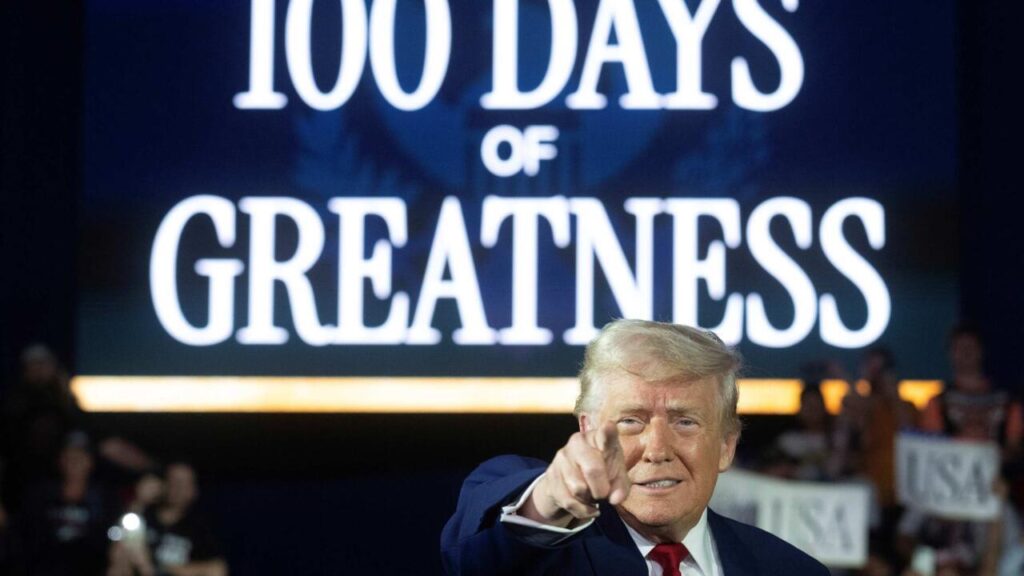
At GLHR Investing, we’re unpacking the whirlwind of President Donald Trump’s first 100 days in office, from January 20 to April 29, 2025. His aggressive tariff policies, deregulation, and immigration crackdowns have reshaped markets and sparked global trade tensions, with the S&P 500 (SPY) down 15.6% since inauguration. But are these moves boosting U.S. revenue, and how are they affecting the global economy? Here’s a comprehensive look at Trump’s actions, their worldwide ripple effects, and whether America is making more money.
- Key Actions in Trump’s First 100 Days (January 20–April 29, 2025):
- Tariff and Trade Policies:
- April 2 “Liberation Day” Tariffs: Trump declared a national emergency under the International Emergency Economic Powers Act (IEEPA), imposing a 10% baseline tariff on all imports, 25% on Canada/Mexico, 54% on China, and up to 50% on select countries, effective April 5–9.
- April 8 Pause: A 90-day pause on most tariffs (except China’s, raised to 125%) was announced, citing negotiations with 75 countries, effective immediately.
- Critical Minerals and Semiconductor Probes (April 15–16): Trump launched a Section 232 investigation into critical minerals (e.g., rare earths, lithium) and a Commerce Department probe into semiconductor imports, signaling potential new tariffs.
- Pharmaceutical Probe: A Commerce Department investigation into drug imports raised fears of healthcare cost hikes.
- Federal Reserve and Monetary Policy Pressure:
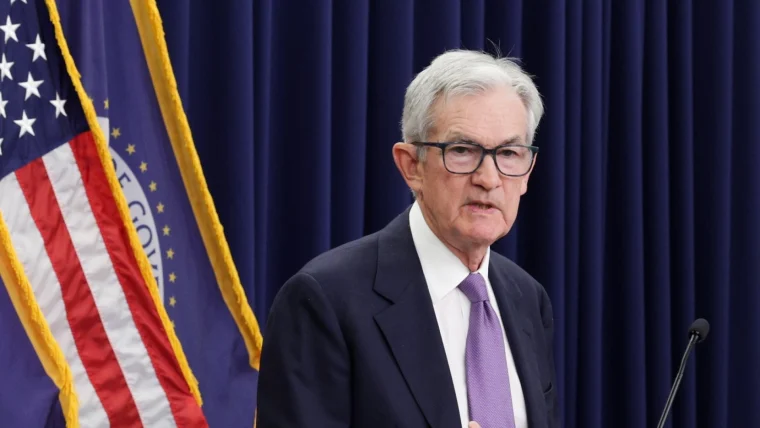
- Trump attacked Federal Reserve Chair Jerome Powell, calling him a “major loser” (April 16) and suggesting his termination (April 21), raising fears of Fed independence erosion. He backed off on April 22, stabilizing markets.
- Powell warned of tariff-driven inflation above 4%, resisting immediate rate cuts, with rates holding at 4.25–4.5%.
- Deregulation and Government Efficiency:
- Through the Department of Government Efficiency (DOGE), led by Elon Musk, Trump slashed federal agencies, including the U.S. Agency for International Development and Department of Education, triggering lawsuits.
- Eliminated 15,000 federal jobs and cut diversity, equity, and inclusion positions at NASA, aiming for a leaner government.
- Immigration and Border Security:
- Economic and Energy Initiatives:
- Other Actions:
- Tariff and Trade Policies:
- Impact on the Global Economy:
- Trade War and Market Volatility:
- Trump’s tariffs triggered a $5 trillion global equity sell-off in early April, with the MSCI World Index down 10% by April 9. China’s 84% retaliatory tariffs and rare earth export bans disrupted tech and auto supply chains.
- The World Trade Organization projected a 0.2–1.5% global trade decline in 2025, with Mexico and Canada’s GDP growth forecasts cut to 1.2% and 1.7%, respectively, due to tariff risks.
- Japan, South Korea, and the EU face pressure to negotiate trade deals, with speculation of closer economic ties to China as U.S. relations fray.
- Currency and Bond Markets:
- The U.S. dollar lost 9% against a basket of currencies since January, per the U.S. Dollar Index, reflecting investor fears of U.S. economic instability.
- U.S. Treasury bonds tanked, with investors shifting to Japanese yen and Swiss franc, signaling a loss of confidence in U.S. debt safety. Yields rose to 4.4% by April 21, easing to 4.28%.
- Recession Risks:
- Economists warn of global stagflation, with growth stalling and inflation rising. J.P. Morgan estimates a 60% U.S. recession probability, with Goldman Sachs at 45%, driven by trade disruptions.
- Businesses worldwide paused expansions, with supply chain chaos likened to the COVID-19 pandemic, per industry reports.
- Allied Relations:
- Trade War and Market Volatility:
- U.S. Revenue Increases:
- Tariff Revenue:
- Trump claimed tariffs generated $2 billion daily, but U.S. Commerce Department data shows $285 million/day on April 25, totaling $16.1 billion for April, up from $128 million/day on January 17, 2025.
- The Yale Budget Lab reports a 28% effective tariff rate, the highest since 1901, boosting customs revenue but falling short of Trump’s $2 billion claim.
- Economists are skeptical of trillions in new revenue, as higher tariffs may reduce import volumes, offsetting gains. Consumers spent 1.4% more in March, likely pre-buying before price hikes, per Commerce Department data.
- Economic Metrics:
- Job Creation: Trump created 345,000 jobs, with 188,000 in non-government sectors and 9,000 in manufacturing, reversing Biden-era losses (6,000 manufacturing jobs lost/month in 2023–2024).
- Price Reductions: Prescription drug prices fell 2%, gasoline prices dropped 7%, and wholesale egg prices halved, though consumer shelf prices lag.
- Investment Claims: Trump touted $5 trillion in investment commitments, with Roche ($50 billion, 1,000 jobs) and Chevron (oil project) verified, but most remain unconfirmed.
- Inflation: Annual inflation hit a six-month low of 2.4% in March, but economists warn tariffs could push it above 4% in 2025.
- Revenue Outlook:
- Tariff revenue ($16.1 billion in April) is a modest increase but far below Trump’s claims. A 2024 economic analysis projected a 10% global tariff could grow the economy by $728 billion and create 2.8 million jobs, but current data shows a Q1 2025 GDP contraction, undermining revenue projections.
- Corporate tax cuts, if extended, could reduce federal revenue by $1 trillion over a decade, offsetting tariff gains, per the Tax Foundation.
- Consumer spending (1.4% up in March) may temporarily boost sales tax revenue, but long-term declines are expected as prices rise.
- Tariff Revenue:
- Stock Market Impact:
- S&P 500 (SPY) Performance:
- Current Price: $513.88 (April 21, 2025), down 2.4% from $526.41, with a monthly range of $536.9 (April 14) to $508.545 (April 16), a 4.3% drop. YTD: down 15.6% since January 20, and 17.6% from February 19’s $613.23 peak, nearing bear market territory.
- Key Events: April 2 tariffs caused a 6% SPY plunge, April 8’s pause sparked a 9.5% rally, and April 16–21 probes and Powell attacks drove a 2.2–2.36% drop. The VIX hit 50 on April 9, signaling extreme fear.
- Sector Impacts:
- Technology: NVIDIA (-6.87% on April 16), Apple (-9%), and AMD faced supply chain hits from semiconductor probes and China’s rare earth bans, with SPLRCT down 4.3%.
- Automotive: Stellantis paused plants, and Tesla fell 44% YTD due to tariff costs, dragging CARZ ETF.
- Retail: Walmart held steady with domestic sourcing, but Nike and Amazon dipped, with XLY ETF down 3%.
- Safe Havens: Gold rose 3% to $3,300/ounce, and utilities (SPLRCU) gained 1%. Treasury yields hit 4.4%, easing to 4.28%.
- Market Sentiment:
- S&P 500 (SPY) Performance:
- Investor Considerations:
- Global Economic Impact:
- U.S. Revenue Reality:
- Tariff revenue ($285 million/day) is up but overstated by Trump ($2 billion/day claim). Job gains (345,000) and price drops (gas, drugs) are positive, but Q1 GDP shrank, and consumer spending may falter.
- Long-term revenue gains depend on trade deal success and avoiding recession, which current policies risk.
- Opportunities:
- Short-Term: Buy gold (GLD) or utilities (XLU) for stability. Walmart and McDonald’s offer defensive retail exposure.
- Long-Term: Infrastructure ETFs (IFRA) could gain from reshoring, if tariffs persist.
- Risks:
- Strategy:
- Allocate 5–10% to safe havens (gold, bonds) to hedge volatility. Trim tech exposure (XLK) and monitor Q1 earnings (ending May 10) for signals.
- Why It Matters: Trump’s first 100 days unleashed a trade war, slashed government spending, and pressured the Fed, driving SPY down 15.6% and shaking global markets. While U.S. tariff revenue rose ($16.1 billion in April), overstated claims and GDP contraction cast doubt on sustained gains. At GLHR Investing, we’re here to help you navigate this chaos, balancing risks with opportunities to build wealth.
Stay resilient with GLHR Investing—let’s thrive in uncertainty!
Disclaimer: GLHR Investing is not a financial adviser; please consult one.